



Why You Don’t Need to Be Flexible to Start Yoga
Yoga is often presented through images of advanced poses, deep backbends, and legs folded into seemingly impossible shapes. Those images can make a beginner believe that flexibility is an entry requirement rather than one possible result of regular practice. In reality, yoga begins with attention: noticing your breath, sensing your body, and meeting yourself honestly in the present moment.
You do not need to touch your toes, sit comfortably on the floor, or know the names of poses before attending a class. You need clothing that allows you to move, a little space, and a willingness to explore without forcing your body into a shape it is not ready to make.
A gentle yoga practice can support mobility, strength, balance, stress relief, and self-awareness at many different starting points. Flexibility may develop over time, but it is only one part of the larger experience.
Flexibility Is Not the Purpose of Yoga
Flexibility describes how much movement is available at a joint or through a group of muscles. Yoga includes stretching, but its purpose is broader than increasing range of motion. A practice may also cultivate steadiness, coordination, strength, breath awareness, concentration, and emotional resilience.
A person who can easily reach their toes may still struggle to breathe calmly, notice tension, or stay present during discomfort. Someone with limited mobility may have a deeply meaningful practice because they are learning to listen carefully and respond with patience. The quality of attention matters more than the visual depth of a pose.
Yoga also looks different from body to body. Bone structure, age, previous injuries, daily activities, muscle tone, connective tissue, and genetics all affect how a posture appears. Comparing your shape with another person’s can turn a supportive practice into a performance. Your version of a pose is valid when it helps you remain aware, steady, and at ease.
Your Starting Point Is Enough
Beginners sometimes wait for the “right” body before joining a class. They may decide to become fitter first, lose weight, improve their balance, or practice stretches at home until they feel less awkward. This postpones the very experience that could help them feel more comfortable in their body.
Starting with limited flexibility is ordinary. Hamstrings may feel tight after long hours of sitting, hips may resist unfamiliar positions, and the spine may not move freely in every direction. None of these sensations means you are failing. They are information about where your body is today.
Appropriate modifications make yoga more accessible. A bent knee can make a forward fold more comfortable. A cushion can support the hips during seated postures. A wall can provide balance, while a chair can make standing or floor-based movements more manageable. Props are not signs that you need extra help; they are tools that allow your body to participate with less strain.
Learn The Difference Between Effort And Strain
Yoga can include effort without becoming a test of endurance. You may feel muscles working, experience a mild stretch, or notice that maintaining a position requires concentration. Strain feels different: sharp pain, pinching, numbness, breath-holding, shaking that cannot settle, or a strong urge to escape the pose.
A useful practice is to keep enough space for your breath. If you cannot inhale and exhale smoothly, reduce the intensity, change the position, or rest. The goal is not to overpower resistance. It is to explore sensation while respecting the body’s signals. This principle is central to holding poses gently, especially when you are still learning how much effort is appropriate.
A yoga teacher can offer options, but you remain the person most able to sense what is happening inside your body. Instructions are invitations rather than commands. You can pause in child’s pose, sit out a movement, or return to an easy shape whenever you need to. Choosing rest is an active part of self-care, not a disruption to the class.
What A Beginner Actually Needs
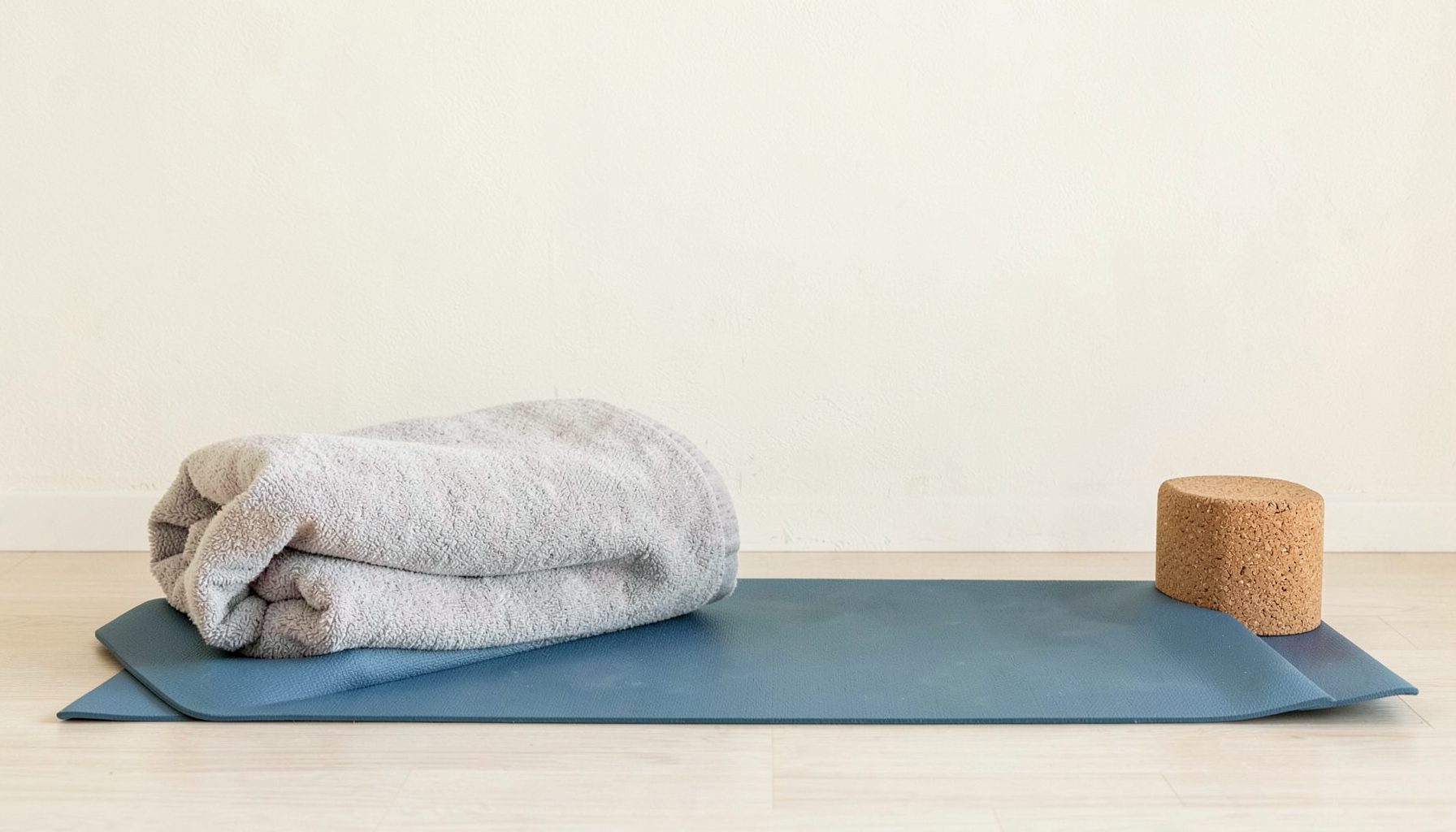
You do not need expensive equipment or a large collection of yoga clothes. A non-slip surface, comfortable layers, and a few minutes of uninterrupted time may be enough. If you practice on a hard floor, a folded blanket can cushion your knees. Books, cushions, towels, and a sturdy chair can often substitute for specialist props.
The most important resource is a manageable approach. A ten-minute practice that you repeat regularly can be more useful than an ambitious session that leaves you sore and discouraged. Begin with simple movements such as shoulder rolls, gentle spinal motion, supported squats, relaxed standing, or slow transitions from sitting to standing.
Breathwork can also be a welcoming starting point. Notice whether your breath is shallow, rushed, or held. Then allow the exhalation to lengthen slightly without forcing a particular rhythm. This shifts yoga away from achieving a shape and toward developing a relationship with your body.
The following comparison shows how common concerns can be reframed into practical choices:
| Common Concern | A More Helpful Perspective | A Simple Starting Option |
|---|---|---|
| “I cannot touch my toes” | Forward folds can be adapted to any range of motion | Bend your knees and rest your hands on blocks or thighs |
| “I am too stiff for yoga” | Stiffness is a starting sensation, not a permanent identity | Try gentle joint movements and short, regular sessions |
| “Everyone will watch me” | Most students are focused on their own breath and practice | Choose a beginner, restorative, or small-group class |
| “I have an old injury” | Individual guidance can help you find safer variations | Tell the teacher beforehand and work within your current limits |
| “I am too old to begin” | Yoga can be adjusted for changing strength, balance, and mobility | Practice with a chair, wall, or seated sequence |
| “I need to master poses” | Awareness and consistency are more important than visual achievement | Stay with one comfortable pose and observe your breath |
A Gentle Practice Builds Trust
When you approach yoga with patience, your body may gradually become more mobile. Muscles can learn to release, joints can move with greater confidence, and strength can support a wider range of motion. Yet the most valuable change may be the trust you develop in your own decisions.
Trust grows when you notice an uncomfortable sensation and respond instead of ignoring it. It grows when you choose a smaller movement and discover that the practice still feels complete. It grows when you stop judging your body for having limits and begin treating those limits as useful boundaries.
This process can also change how you relate to flexibility outside the studio. You may become more aware of how stress affects your shoulders, how sitting influences your hips, or how fatigue changes your balance. Yoga becomes less about collecting impressive poses and more about building a sustainable relationship with movement.
Progress is rarely a straight line. You might feel open one morning and restricted the next. Sleep, mood, temperature, stress, menstrual cycles, illness, and daily activity can all affect mobility. A fluctuating practice is still a valid practice. There is no need to force yesterday’s range of motion into today’s body.
Choose Supportive Ways To Begin
The style and setting of your first class can shape your expectations. Look for descriptions such as gentle, beginner-friendly, restorative, slow flow, accessible, or chair yoga. These classes usually allow more time for instructions, transitions, modifications, and rest than fast-paced sessions.
It can be helpful to contact a teacher before attending if you have an injury, chronic condition, pregnancy, balance concerns, or anxiety about starting. A skilled teacher should be able to explain how the class can be adapted and should welcome questions about comfort and safety.
You can also begin privately at home with a short sequence. Move slowly enough to notice where you are gripping. Keep the range of motion small. Use the floor, wall, or chair for support. If a movement creates pain or uncertainty, leave it out and return to breathing or resting.
Build your first weeks around choices that encourage consistency:
- Practice for five to fifteen minutes rather than setting an unrealistic daily target.
- Use props and modifications from the beginning instead of waiting until a pose feels difficult.
- Let your breathing guide the intensity, and pause whenever it becomes strained.
- Record sensations such as ease, tension, energy, and mood instead of measuring progress by flexibility alone.
- Choose teachers and classes that emphasize consent, self-compassion, and individual variation.
Let Yoga Meet You Where You Are
The belief that you must be flexible before starting yoga usually comes from confusing appearance with experience. A posture may look simple while requiring considerable strength and control, and an adapted version may offer just as much awareness as a more advanced expression.
Yoga is available in a chair, beside a wall, on a mat, in bed, or during a quiet pause at work. It can be a few mindful breaths, a gentle stretch after waking, or a slower response to tension in the middle of a busy day. The practice becomes yours when you stop trying to resemble someone else and begin listening to what you need.
Give yourself permission to start small and remain curious. Explore a gentle class, download a short practice, or set aside a few minutes to breathe and move without judging the result. Your body does not need to prove its flexibility before it deserves care; the practice can begin exactly where you are.