



Why Your Wrists Hurt in Downward Dog and How to Fix It
Downward Dog can look like a simple resting pose, yet it places a meaningful amount of weight through the hands, fingers and wrists. If your wrists ache, feel compressed or become sharp and sore after a few breaths, the pose may be revealing a problem with load, alignment, mobility or timing rather than a lack of strength.
A gentler approach can make a substantial difference. Small changes to hand position, shoulder action, leg bend and practice volume often reduce irritation while helping you build a more sustainable relationship with yoga. Pain is useful information, so the aim is not to force your wrists to tolerate the pose, but to understand what they need.
What Happens To Your Wrists In Downward Dog
In Downward Dog, your wrists are extended, meaning the top of the hand moves towards the forearm while the palm remains on the floor. This position can be demanding because your body weight travels through the hands at an angle. The amount of pressure varies according to your shoulder mobility, leg length, hamstring flexibility and how far your heels move towards the mat.
Many people also shift too far forwards. If the shoulders drift well beyond the wrists, the hands carry more weight and the wrist joint reaches a deeper angle. This can happen during a vinyasa, especially when you move quickly from Plank to Downward Dog or try to create a long, dramatic shape.
A mild stretching sensation across the wrists may be acceptable, but pinching, burning, numbness, tingling or a sharp twinge deserves attention. Pain that lingers after class, affects gripping or appears during everyday activities such as opening a jar should be assessed by a qualified health professional.
Check Your Hand And Shoulder Position
Place your hands about shoulder-distance apart, with fingers spread comfortably rather than forced wide. Press through the pads beneath the index finger and thumb, as well as the base of each finger. This creates a more even foundation than collapsing towards the outer heel of the hand.
Your middle fingers can point towards the front of the mat, though the ideal angle differs between bodies. Some practitioners feel better with the hands turned slightly outwards. Try a small adjustment instead of assuming there is one perfect alignment rule for everyone.
Push the floor away and allow the upper arms to rotate gently outwards, as though the inner elbows are facing one another. Keep the shoulders away from the ears without pulling the shoulder blades rigidly down your back. This active upper-body support can reduce the tendency to sink into the wrists.
Let Your Legs Share The Load
Downward Dog becomes more intense when you try to straighten the legs, lower the heels and lengthen the spine all at once. Tight hamstrings or calves can pull the pelvis backwards, encouraging the spine to round and the shoulders to move forwards. The hands then end up doing more work.
Bend your knees generously and lift your sitting bones towards the ceiling. Think of the pose as an upside-down V shaped by the length of your spine, rather than a test of how close your heels can get to the floor. A soft bend in the knees can give your back and shoulders more space and make weight distribution easier.
You can also widen the distance between your hands and feet slightly. If your stance is too short, your shoulders may sit well past your wrists. Walk the feet back until your ribs, pelvis and arms feel connected, then keep the heels lifted without treating that as a failure.
Use Props And Alternative Shapes
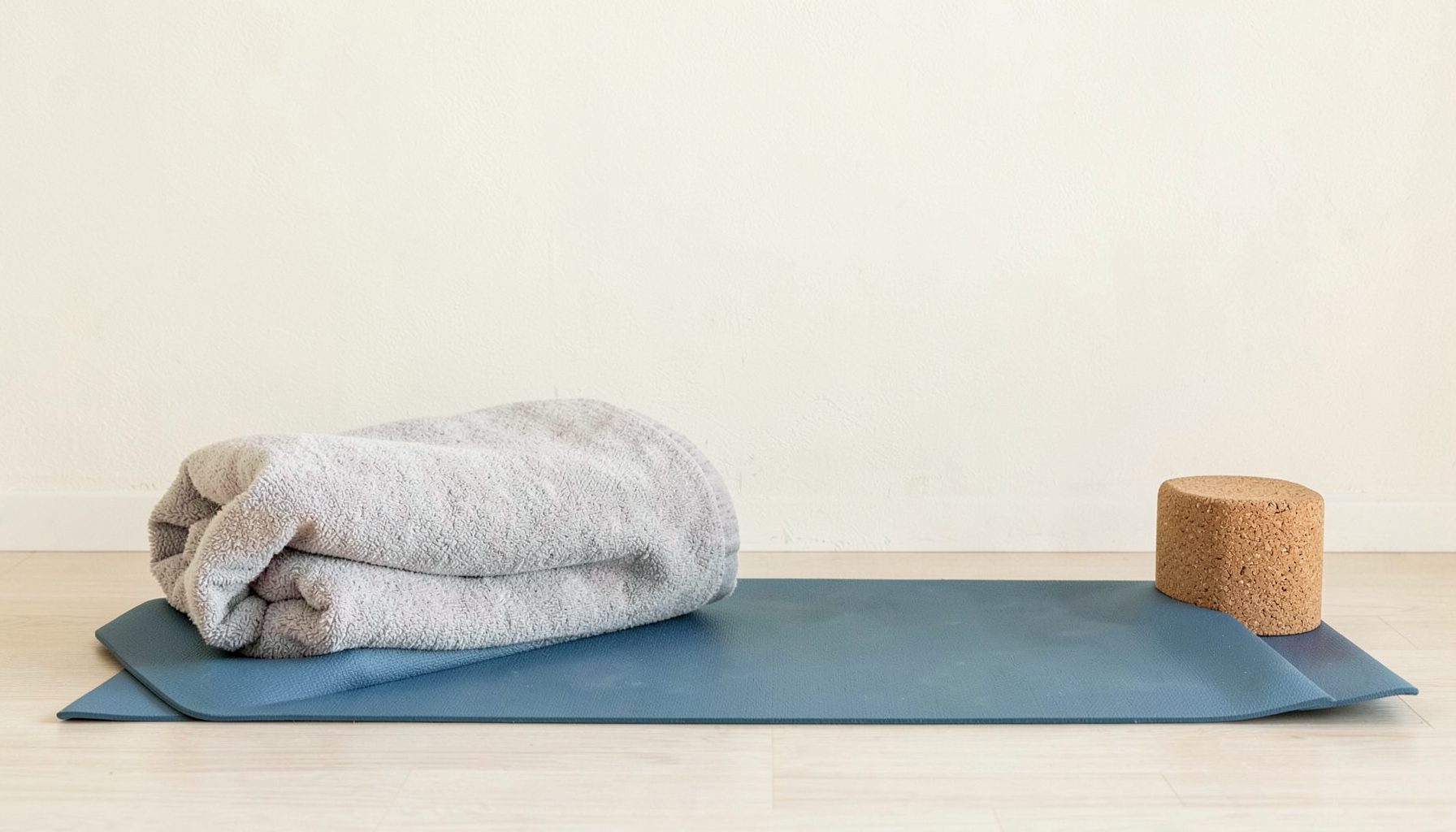
A folded yoga mat or firm wedge beneath the heels of the hands can reduce the degree of wrist extension. The fingers remain on the floor while the heel of the hand sits on a slightly raised surface. Test the height carefully, and stop if the wedge creates pressure in the thumb or makes the hands slide.
Some people benefit from placing the hands on yoga blocks in their lowest or middle position. This raises the upper body and can decrease the load through the wrists, although stability matters. Blocks should sit on a non-slip surface and should not wobble beneath you.
For a stronger wrist-friendly alternative, practise Downward Dog with your forearms on the mat, or try Puppy Pose with the hips over the knees. A wall-supported version, with the hands at shoulder height and the body angled back, can also develop shoulder strength without requiring full wrist extension.
These options are particularly useful in a home practice on timber flooring or tiles, common in Australian homes where a mat may move slightly on a hard surface. Place a non-slip layer underneath and avoid practising beside furniture that could shift if you need to step out of the pose.
Build Wrist Capacity Gradually
Wrist strength and tolerance can improve through small, regular exposures. Begin on hands and knees, with the shoulders above the wrists, and gently shift your body a few centimetres forwards and backwards. Keep the fingers active and move slowly enough to notice where the pressure goes.
You can then explore lifting one palm at a time, making soft fists, or turning the fingers slightly outwards before returning to a neutral position. These movements are not a competition. Five controlled repetitions may be more useful than a long set that leaves the joints irritated.
Include weight-bearing practice in short doses rather than placing every demanding pose in one session. For example, you might hold Tabletop for three breaths, rest in Child’s Pose, then repeat twice. Over several weeks, gradually add time in Downward Dog if your wrists feel normal later that day and the following morning.
A few minutes of forearm, shoulder and finger preparation can be valuable before a flow class. On a warm Queensland afternoon, it can be tempting to move straight into a vigorous sequence because your muscles already feel loose, but heat does not automatically mean your joints are prepared for repeated loading.
Notice Your Practice Habits
Wrist discomfort is sometimes linked to the way a class is structured rather than one pose in isolation. Repeated transitions through Plank, Chaturanga and Downward Dog can create a high volume of wrist extension. Fast-paced classes may give you little time to adjust your hands or shift your weight with care.
Try stepping back to Downward Dog instead of jumping, and lower your knees before moving through a transition. You can also replace several rounds of Sun Salutations with standing poses, a lunge sequence or a breath-led pause. A teacher should be comfortable offering these modifications without making you feel that you are opting out.
Take note of the circumstances around the pain. Does it appear first thing in the morning, after computer work, following rock climbing or during a class at a heated studio? Someone spending the day typing in a Sydney office may need a different approach from a gardener, massage therapist or tradie whose hands are already working hard.
Food and hydration do not correct wrist alignment, but they can influence how supported you feel in practice. If you often arrive hungry or uncomfortable after a long commute, these mindful pre-practice eating ideas may help you plan a more settled session.
Know When To Rest And Seek Support
Stop the pose if you feel sharp pain, electric sensations, numbness, loss of grip or pain that travels into the forearm. Resting does not mean abandoning your practice. You can work with breath, seated mobility, standing balance, gentle twists or a guided meditation while the irritated area settles.
Persistent symptoms are worth discussing with a physiotherapist, occupational therapist or doctor. This is especially important if you have had a wrist fracture, ligament injury, tendon problem, arthritis or surgery. A yoga teacher can help with technique and alternatives, but cannot diagnose the cause of pain.
Seek prompt medical attention after a fall or sudden injury, particularly if there is visible swelling, deformity, significant weakness or an inability to bear weight through the hand. If discomfort continues for more than a week or repeatedly returns whenever you practise, do not keep testing it through pain.
A qualified teacher can observe details that are difficult to sense alone, such as whether your fingers are gripping, your elbows are locking or your weight is shifting to one side. In Australia, look for a teacher who understands modifications and is willing to work with your individual history rather than insisting that every body match the same shape.
Create A More Comfortable Downward Dog
Start with a brief check-in before entering the pose. Notice whether your wrists already feel stiff, whether your shoulders are tired and whether your fingers can spread comfortably. Come to hands and knees, set the palms deliberately, then lift the hips with bent knees and a long spine.
Hold for three to five breaths, keeping the heels lifted and pressing through the fingertips. If the wrists feel calm, stay for another breath or two. If pressure builds, lower the knees, rest in Child’s Pose or come to standing. The goal is a clear conversation with your body, not a longer hold at any cost.
You might practise this sequence before a class: wrist circles, finger pulses, Tabletop shifts, a short Puppy Pose and one supported Downward Dog. Over time, reduce the height of your props or lengthen the hold only when the current version feels steady. Progress is measured by comfort, control and recovery, rather than by how flat your heels become.
A sustainable practice also includes days when Downward Dog is not the right choice. An early-morning beach session on the Mornington Peninsula, a lunchtime class in Melbourne or a retreat in the Blue Mountains may all have different surfaces, temperatures and teaching styles. Adapt the pose to the conditions and to your energy on that particular day. If restorative time appeals, Australian yoga retreat options can offer space to explore movement and rest with attentive guidance.
The most useful adjustment is often the simplest: move the shoulders back towards the hips, bend the knees, spread the fingers and press actively into the floor. Practise for a few breaths, reassess afterwards and build gradually. Your practical takeaway is to treat wrist comfort as a guide: modify early, share the load across your whole body and choose a version of Downward Dog that leaves you feeling supported rather than strained.