



Building a Home Practice When You Have No Space
A home yoga practice does not require a dedicated studio, a spare bedroom, or enough floor space to stretch out in every direction. It can begin beside your bed, between the sofa and coffee table, or in a quiet corner of a shared room. The quality of your practice comes less from the size of the room than from the care you bring to the moment.
When space is limited, the invitation is to make yoga simpler. You may focus on breathwork, seated movement, standing poses, meditation, or a few deliberate stretches rather than trying to recreate a full-length class. A small area can still support grounding, mobility, strength, and self-compassion.
Building a home practice when you have no space also gives you a chance to release strict ideas about what yoga should look like. Your practice can adapt to your surroundings, your energy, and the time available. With a few practical adjustments, even a compact living environment can become a supportive place to reconnect with yourself.
Start With The Space You Already Have
Begin by noticing where your body can move safely, rather than searching for the perfect yoga area. A strip of floor beside the bed may be enough for seated twists, cat-cow variations, bridge pose, gentle core work, and breathing exercises. If the floor is crowded, a firm chair can support a complete practice focused on posture, balance, and mobility.
Move only what is necessary. A folded blanket, small cushion, or pair of books can create enough room for your body without requiring a major rearrangement. You might slide a coffee table aside for ten minutes, roll up a rug, or use the space at the foot of the bed. Returning objects afterward can become part of the ritual, keeping the practice practical rather than disruptive.
Safety matters more than appearance. Check that your hands and feet will not slip, remove sharp or unstable objects from nearby, and leave enough clearance for your arms. If you practice near a wall, use it for balance and support rather than treating it as an obstacle. Your environment does not need to look serene to hold a meaningful practice.
Let Props Become Small And Portable
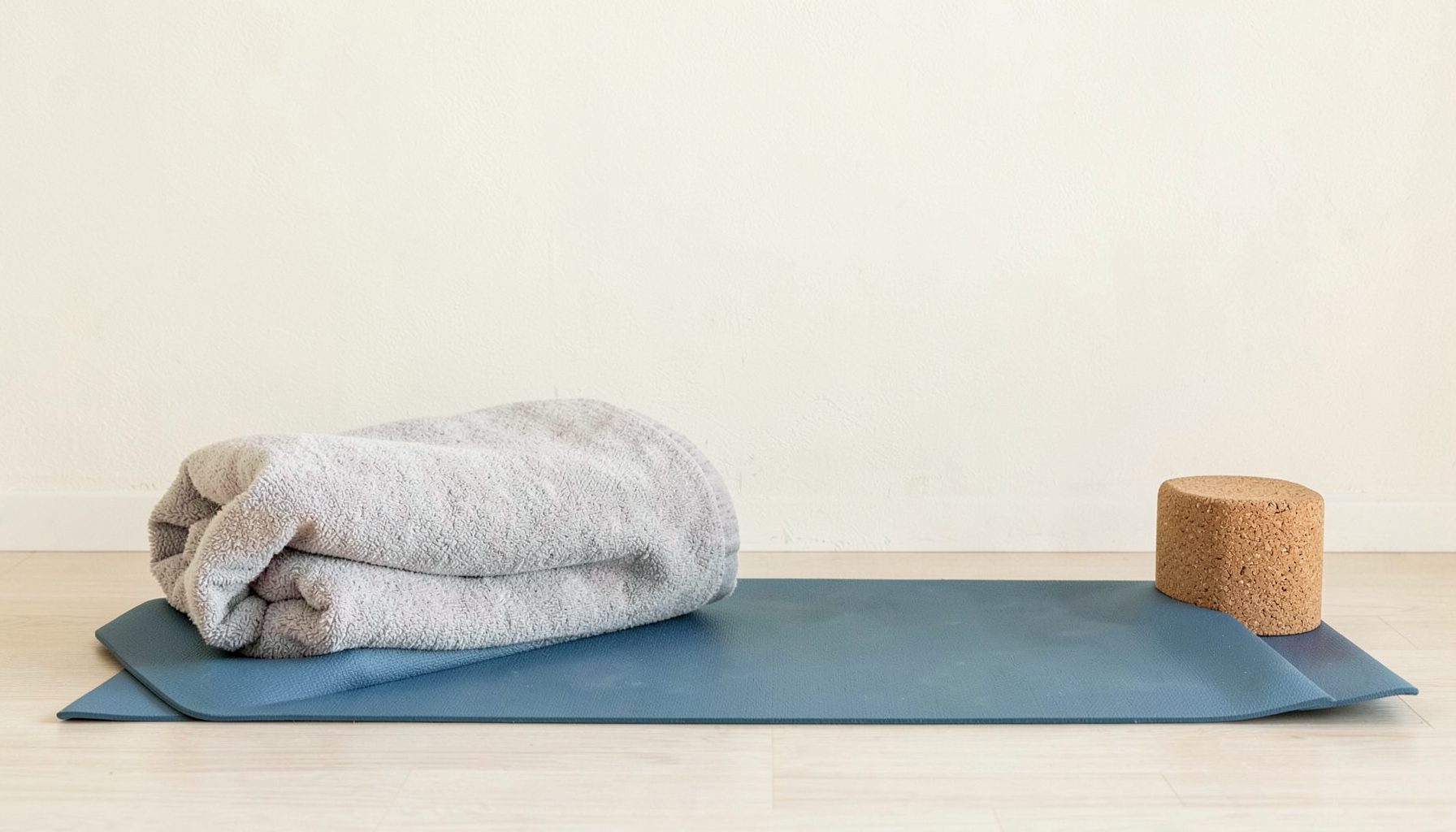
A minimalist setup can remove much of the pressure associated with home yoga. A mat is helpful, but it is not essential for every practice. A carpet, folded blanket, or towel may provide enough comfort for floor-based movement. A sturdy chair can replace blocks, a wall can support balance, and a cushion can make seated meditation more accessible.
Keep your essentials together in a basket, drawer, or small bag. You might include a strap, blanket, eye pillow, and printed sequence, but you do not need a large collection of equipment. When props are easy to find, beginning feels less like a household project and more like a natural part of the day.
Digital resources can also support a compact practice because they do not take up physical room. A short meditation, audio breathing exercise, or printable sequence can guide you without requiring a screen positioned across a large floor. Gentle yoga resources can offer inspiration for practices that emphasize mindfulness, breath, and sustainable movement rather than performance.
Choose Movements That Fit A Compact Room
Small spaces are often best suited to practices with a clear purpose. Instead of trying to include every familiar pose, choose movements that meet your needs that day. A five-minute sequence for stiff shoulders will look different from a calming practice before sleep or a grounding routine between work meetings.
Seated poses are especially useful when the floor area is limited. Try seated side bends, ankle circles, gentle spinal twists, neck movements, and coordinated arm raises. These movements can release tension without requiring wide transitions. A chair-based sequence may include seated cat-cow, supported forward folding, heel lifts, and standing stretches with both hands resting on the chair.
Standing yoga can also work in a narrow area when you reduce the size of each shape. Practice mountain pose, supported tree pose, standing side bends, shoulder rolls, and slow squats. You do not need to extend your arms to their fullest range if furniture or walls are close. The aim is attentive movement, not achieving a particular visual form.
| Your available area | Practices that fit well | Helpful support |
|---|---|---|
| Beside the bed | Breathing, seated twists, gentle stretches | Cushion or folded blanket |
| A narrow hallway | Standing balance, calf stretches, mindful walking | Wall for stability |
| In front of a chair | Chair yoga, mobility, supported squats | Sturdy chair |
| A small patch of floor | Bridge pose, supine stretches, meditation | Mat, rug, or towel |
| A shared living room | Breathwork, slow standing flow, restorative poses | Basket for quick storage |
Use Breath To Expand The Practice
When physical movement is restricted, breathwork can give your practice depth. A few slow breaths can shift attention away from noise, tasks, and visual clutter. Try lengthening the exhale without forcing it, or pause briefly after each exhalation to notice the body settling.
You can practice breathing while seated on a chair, lying on the bed, or standing with your back supported by a wall. Place one hand on your ribs and one on your abdomen, allowing the breath to remain comfortable and natural. If counting helps, inhale softly for four counts and exhale for four or five. Return to an uncounted breath if counting creates tension.
Mindfulness does not require silence or isolation. Notice the feeling of your feet on the floor, the movement of your ribs, or the temperature of the air around your face. Household sounds can become part of the practice rather than proof that you are doing it incorrectly. This approach makes a home yoga routine more resilient when other people, pets, or daily responsibilities are nearby.
Adapt The Routine To Real Life
A sustainable practice needs to fit the life you actually live. If mornings are busy, you might practice three minutes of breathing before checking your phone. If evenings are more spacious, choose restorative poses and a brief body scan. A short routine repeated consistently can be more supportive than an ambitious sequence that becomes difficult to maintain.
Create a few versions of your practice for different circumstances. One might be a standing sequence for days when the floor is occupied. Another could be a chair routine for low-energy mornings. A third might involve lying down, breathwork, and meditation when movement does not feel appropriate. This gives you options without turning each practice into a decision-making challenge.
Interruptions are part of home practice. If someone enters the room, a delivery arrives, or you lose focus, simply pause and begin again when possible. You can also practice in smaller portions: two minutes of mobility before work, a breathing pause at midday, and a calming stretch before bed. These fragments still create continuity.
Build A Rhythm That Feels Supportive
Choose a reliable cue rather than waiting for ideal motivation. You might practice after brushing your teeth, before opening your laptop, after putting children to bed, or when you change into comfortable clothes. The cue helps yoga become connected to an existing part of your day.
Keep your first commitment modest. Five or ten minutes may be enough to establish trust with yourself. Include one breath practice, two or three movements, and a quiet pause at the end. As the habit becomes familiar, you can extend the time when your body and schedule genuinely allow it.
Self-compassion is central to a lasting home practice. Some days will include strong movement; other days may offer only a few breaths in bed. Neither version needs to be judged. Yoga can support you through changing energy, limited mobility, emotional strain, and busy seasons when your available space and attention are both reduced.
Make Small Choices That Keep You Practicing
A few deliberate decisions can make a cramped practice area feel more workable. Keep them simple enough to use immediately rather than treating them as a renovation project.
- Clear one repeatable patch of floor, even if it is only large enough for seated movement.
- Store a cushion, blanket, and strap together so your setup takes less than a minute.
- Prepare short routines for standing, chair-based, floor-based, and restorative practice.
- Use a wall or sturdy furniture for balance, while checking that it will not shift.
- End each session with one quiet breath and notice how the practice affected your body.
The most useful arrangement is the one that lowers resistance. If your mat must be unrolled in a crowded room, give yourself permission to practice without it. If noise is unavoidable, include sound in your awareness. If your schedule changes daily, use a menu of practices instead of a fixed routine.
Let Your Practice Grow With You
A small home practice can become a place of steadiness without taking over your home. Over time, you may discover that the limitations of your space have sharpened your attention. You learn to move with greater awareness, transition more slowly, and value the subtle effects of breath and presence.
Let your practice remain responsive. Some weeks may call for mobility and energy; others may ask for rest, meditation, or gentle restorative poses. There is no requirement to make every session impressive. The purpose is to create a dependable moment in which you can listen to yourself.
Choose one clear starting point today: sit on a chair for five mindful breaths, stretch beside your bed, or move one small object to create room for practice. Return to that action regularly, allowing consistency rather than available square footage to shape your yoga journey.